

Cardiac Rehabilitation Perth, Murdoch Square
Following a cardiac event or procedure, it's understandable to have questions about returning to exercise, particularly how hard you can train and what activities are appropriate for your condition.
Our approach begins with understanding your cardiovascular health, current physical capacity and rehabilitation goals. From there, we develop a structured exercise program combining progressive aerobic exercise with strength and conditioning to improve cardiovascular fitness, muscular strength, exercise tolerance and overall physical capacity.
Throughout rehabilitation, we monitor your response to exercise, progressively adjust your training and help you understand how to manage exercise intensity, symptoms and cardiovascular load.
As your fitness and physical capacity improve, rehabilitation can progress beyond early recovery towards more advanced cardiovascular conditioning, strength training and cardiovascular performance, with the aim of supporting independent exercise, continued physical development and long-term cardiac care.
Conditions we treat
Structural Heart conditions
We provide detailed, in-depth education around your specific structural heart condition, exercise education, and individualised exercise programming for people living with structural heart conditions, including:
Heart valve conditions, including bicuspid aortic valve
Aortic dilatation and aortic aneurysm
Following heart valve repair or replacement
Congenital heart conditions
Other structural heart conditions
Your consultation goes beyond simply providing an exercise program. We'll help you understand your condition, how different types of exercise affect your cardiovascular system, and what this means for the way you train.
We'll translate your medical recommendations into practical exercise guidelines, including exercise intensity, aerobic training, resistance training, blood pressure management, progression, and relevant precautions.
Heart Conduction issues
We provide individualised exercise guidance and structured exercise programs for people managing heart rhythm and conduction conditions, including:
Atrial fibrillation and atrial flutter
Bradycardia and other conduction abnormalities
Heart block
Pacemakers
Implantable cardioverter defibrillators (ICDs)
Other medically managed heart rhythm conditions
We'll help you understand how your condition, medications, and any implanted cardiac device may influence your heart-rate response and exercise intensity, with practical guidance on aerobic exercise, strength training, monitoring and appropriate progression.
Coronary Artery Disease and Cardiac Events, including pre and post-operative cardiac care
We provide structured cardiac rehabilitation, exercise education and individualised exercise programs for people recovering from or managing:
Coronary artery disease
Heart attack
Angina
Coronary stent procedures (PCI)
Coronary artery bypass surgery (CABG)
We'll help you understand how your heart responds to exercise and medication, and provide practical guidance on aerobic exercise, strength training, exercise intensity, and progression to help you safely rebuild your cardiovascular fitness, strength, and physical capacity.
Our Cardiac Rehabilitation Structure
Initial Consultation
1 hour
Your initial consultation begins at Murdoch Square. It is an opportunity for us to understand your cardiac history, discuss any concerns you have about exercise and establish a suitable starting point for your rehabilitation.
We'll review your medical history, medications, cardiovascular risk factors and any relevant blood test results or cardiologist reports.
Where clinically appropriate, your assessment will include a submaximal graded exercise bike test to evaluate your cardiovascular response to exercise, alongside functional assessments to establish your current physical capacity.
We'll also discuss your rehabilitation goals, provide guidance on exercising with your condition, and develop an individualised exercise program based on your assessment findings.
What to Bring
Medicare card and private health insurance details
Relevant cardiac medical history, discharge summaries or surgical reports, if available
A current list of medications
Comfortable clothing suitable for exercise testing
Please allow 45–60 minutes for your initial consultation.
Locations
Murdoch Square
Subsequent Rehabilitation session
45 Minutes
Our 1:1 rehabilitation sessions provide supervised exercise tailored to your cardiac condition, current physical capacity and rehabilitation goals.
Sessions combine progressive aerobic exercise with strength and conditioning, with exercise intensity and training loads adjusted according to your cardiovascular response, symptoms and progress.
We'll also introduce exercises you can perform independently at home or at your own gym, helping you gradually build your confidence and ability to manage your exercise outside supervised sessions.
For clinically stable individuals who are suitable for higher-intensity exercise, rehabilitation can progress into more advanced gym-based strength and conditioning.
Locations
Murdoch Square
Subiaco
Subsequent Consultation
30 Minutes
These consultations are designed for patients who have progressed to exercising independently at home or at their own gym and require ongoing guidance with their cardiac rehabilitation.
We'll review your progress, discuss any concerns or difficulties you've experienced and make appropriate adjustments to your exercise program as your fitness and physical capacity improve.
Consultations also provide an opportunity to discuss cardiovascular load management, exercise intensity, blood pressure responses and strategies for safely progressing your aerobic and strength training.
The aim is to support you in managing your exercise independently while continuing to improve your cardiovascular fitness, strength and physical capacity.
Location
Murdoch Square
Subiaco
Cardiac Reassessment
30 minutes
This consultation typically involves a reassessment to look at changes in performance, and a report will be sent to the cardiologist. A submaximal graded bike exercise test will be conducted, measuring watts, heart rate, and blood pressure cardiovascular response to submaximal loads
Locations for this service
Murdoch Square
Why Commit to a cardiac rehbilitation program
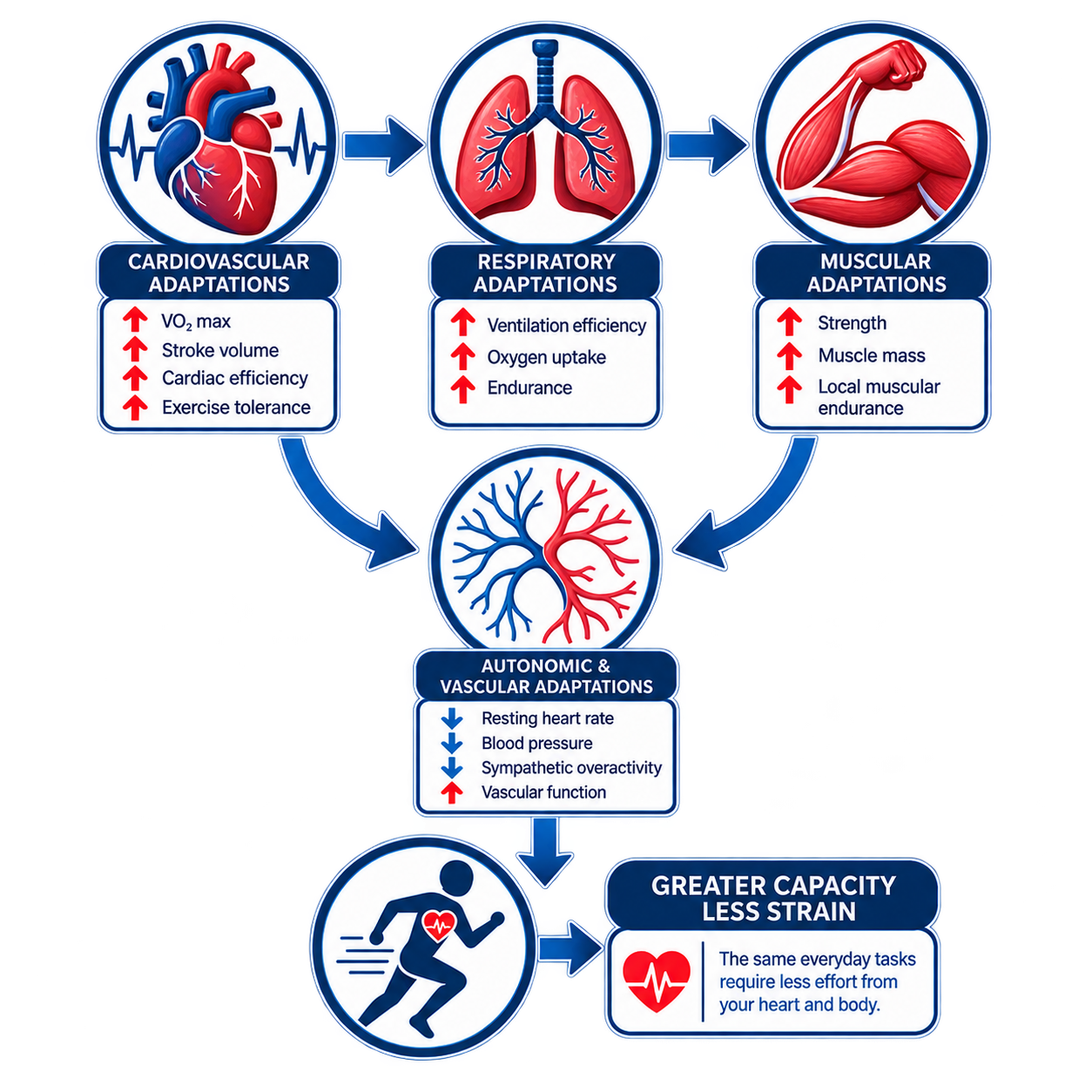
Following a cardiac event, surgery or a diagnosis of cardiovascular disease, you may notice that activities you previously found easy have become more demanding. Cardiac rehabilitation can help you progressively rebuild your fitness, strength and confidence with exercise.
Aerobic Exercise
Aerobic exercise helps improve your heart's ability to support physical activity and your body's ability to deliver and use oxygen.
As your cardiovascular fitness improves, activities such as walking, climbing stairs and recreational exercise can become easier and less physically demanding.
Strength & Resistance Training
Strength training helps rebuild muscle strength and physical capacity, particularly if you've experienced a period of reduced activity following a cardiac event or surgery.
As your muscles become stronger, everyday activities such as climbing stairs, carrying groceries and getting up from a chair require less effort relative to your strength.
Building Your Long-Term Physical Capacity
Combining aerobic exercise with strength training allows us to address both your cardiovascular fitness and muscular strength.
As you progress, your rehabilitation program can be adjusted to help you return to your usual activities, exercise independently and maintain your physical fitness over the longer term.
Is weight training dangerous with a heart condition? No.
Strength training is an important part of cardiac rehabilitation, helping you rebuild muscular strength and improve your ability to perform everyday activities. The greater amount of force your msucles can produce with less oxygen demand, the less load it places on your heart.
When you lift weights, your heart rate and blood pressure naturally increase to meet the demands of your working muscles. This is a normal response to exercise.
However, lifting weights can temporarily produce substantial increases in blood pressure, particularly during strenuous exercise. As blood pressure rises, the heart has to work harder to pump blood, increasing its workload and oxygen requirements.
For people with certain cardiovascular conditions, particularly coronary artery disease, where blood flow to the heart muscle may be restricted, or for structural heart conditions, excessive cardiovascular demand can be a concern.
This doesn't mean you need to avoid strength training. Exercise selection, training intensity, the amount of muscle involved, repetitions, breathing, and recovery all influence how your cardiovascular system responds. We are primarily focused on increasing the stimulus to the muscle with minimal cardiac load
Our approach is to prescribe and progressively adjust strength training around your cardiac condition, cardiovascular response, and current physical capacity, allowing you to develop muscular strength while managing cardiovascular load
Cardiac Travel Advice
We also provide extensive education around traveling to physiologically demanding environments, such as excessive prolonged heat exposure and altitude, to ensure you are informed and safe during your trip
Have a Question About Cardiac Rehabilitation?
Submit the form below to discuss your heart health, exercise concerns and rehabilitation goals.
Every person's cardiac history, treatment, medications and physical capacity are different. Whether you're recovering from a recent cardiac event or procedure, managing an existing heart condition, or looking to rebuild your fitness and confidence with exercise, we can help develop an exercise approach appropriate to your individual circumstances.